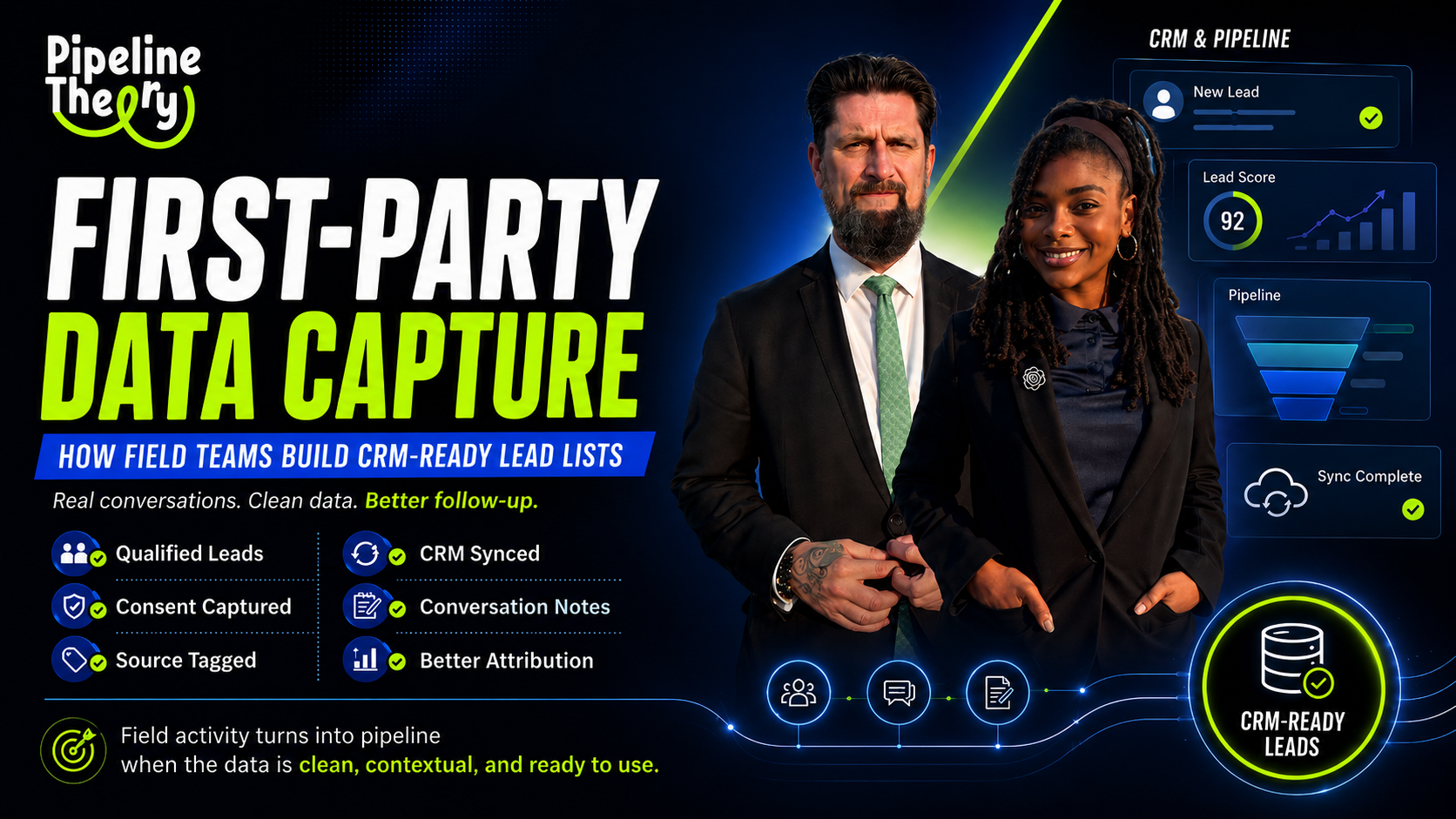
A strong sales pipeline does not begin with a spreadsheet full of random contacts. It begins with clean, useful, first-party data collected from real customer conversations.
For growth-stage brands, field marketing can do more than generate awareness or short-term sales activity. When it is structured properly, it can create a reliable source of first-party data that feeds the CRM, supports follow-up, improves attribution and helps teams understand which prospects are most likely to convert.
That is the difference between collecting names and building a pipeline.
What Is First-Party Data Capture?
First-party data is information a customer or prospect shares directly with a brand. In a field marketing environment, this may happen during a pop-up, event, street team activation, product demonstration, sales conversation or market test.
This data may include:
- Name
- Email address
- Phone number
- Location
- Product interest
- Buying timeline
- Preferred contact method
- Lead source
- Conversation notes
- Qualification status
- Consent for follow-up
The value of first-party data is that it comes from a direct interaction. It is not guessed, purchased or inferred from a third-party source. It is built from real conversations with real people.
For a field-first direct marketing team like Pipeline Theory, this matters because the goal is not only to start conversations. The goal is to turn those conversations into a repeatable sales pipeline.
Why Field Teams Are Valuable for First-Party Data
Digital campaigns can capture forms, clicks and online behaviour. Field teams capture something different: context.
A trained representative can understand why a customer is interested, what question made them hesitate, which offer caught their attention and what next step feels realistic.
That context is what makes a lead more useful.
For example, two leads may both provide an email address. But one may be ready to buy this week, while the other is only curious. Without proper lead notes and qualification, both contacts look the same in the CRM.
Field teams can help prevent that problem by collecting data that explains the quality of the opportunity, not just the existence of the contact.
Clean Data Starts With a Clear Capture Standard
A field campaign should not leave data collection up to individual habits. Every team member needs a clear standard for what should be captured and how it should be entered.
Before launch, the campaign should define:
- Which fields are required
- Which fields are optional
- What counts as a qualified lead
- How lead source should be labelled
- How consent should be recorded
- What notes should be added
- How duplicate leads should be handled
- How quickly data should sync into the CRM
This keeps the pipeline organised from the beginning.
Without a capture standard, the CRM can quickly become messy. Missing phone numbers, unclear notes, duplicate records and inconsistent lead sources make it harder for sales teams to follow up and harder for managers to measure performance.
The Difference Between a Contact and a Qualified Lead
Not every contact is a qualified lead.
A contact is someone who shared information. A qualified lead is someone who matches the campaign’s target audience and shows a level of interest that justifies follow-up.
Field teams should be trained to identify the difference.
A qualified lead may have:
- A relevant need
- A clear interest in the product or service
- A realistic timeline
- Accurate contact details
- Permission for follow-up
- A reason to continue the conversation
This does not mean every qualified lead is ready to buy immediately. It means the contact has enough potential to enter the sales pipeline with context.
That distinction protects the CRM from becoming overloaded with low-quality data.
Why Lead Source Tracking Matters
Lead source tracking helps brands understand where opportunities are coming from.
In field marketing, this may include:
- Specific event location
- Pop-up campaign
- Street team route
- Retail environment
- Market test
- Sales representative
- Time of day
- Offer variation
- QR code or landing page
When this data is captured correctly, brands can see which environments produce the strongest pipeline opportunities.
For example, one location may generate a high number of contacts but a low conversion rate. Another location may generate fewer leads but stronger sales outcomes. Without lead source tracking, that insight can be missed.
Pipeline Theory’s Services page highlights lead generation, list building, CRM-ready contacts, data, analytics and CRM integration. These services are strongest when lead source data is clean from the beginning.
CRM-Ready Leads Need More Than Contact Details
A CRM-ready lead should give the sales team enough information to continue the conversation without starting from zero.
Useful CRM notes may include:
- What the customer asked about
- Which objection came up
- What benefit created interest
- Whether pricing was discussed
- Whether the customer requested follow-up
- What next step was agreed
- How soon the customer may be ready to act
This type of information helps the follow-up team speak with relevance.
Instead of sending a generic message, the team can reference the original conversation and guide the prospect towards the next step.
How First-Party Data Improves Attribution
Attribution is one of the biggest challenges in offline customer acquisition. Brands need to know which activity created which result.
Clean first-party data helps connect the dots between field activity and revenue.
A strong attribution process can show:
- Which campaign generated the lead
- Which representative captured it
- Which location produced it
- Which offer was used
- When the lead entered the CRM
- Whether the lead converted
- How much revenue was created
This helps brands measure more than surface-level activity. It helps them understand which field efforts actually contribute to the pipeline.
Common Data Capture Mistakes to Avoid
Even strong campaigns can lose value when data capture is weak.
Common mistakes include:
1. Collecting Too Little Information
If the team only collects a name and email, the sales team may not know how to follow up effectively.
2. Collecting Too Much Information
If the form is too long, customers may stop engaging. The goal is to collect enough data to support follow-up without making the interaction feel difficult.
3. Using Inconsistent Lead Labels
If one team member writes “hot lead” and another writes “interested customer”, reporting becomes harder. Labels should be standardised.
4. Failing to Capture Consent
Teams should have a clear process for recording permission to contact the prospect again.
5. Waiting Too Long to Sync Data
The longer data sits outside the CRM, the higher the risk of delays, errors and lost opportunities.
Building a Better Data Capture Workflow
A strong first-party data workflow should be simple, repeatable and easy for the field team to use.
A practical workflow may look like this:
- Start the conversation.
- Qualify the customer’s interest.
- Capture essential contact details.
- Record consent.
- Add short conversation notes.
- Tag the correct source.
- Sync the lead into the CRM.
- Review lead quality daily.
- Adjust the campaign based on results.
This process turns field activity into usable pipeline data.
Final Thoughts
First-party data capture is not just an admin task. It is a core part of building a repeatable sales pipeline.
When field teams collect clean, qualified and properly tagged data, brands can improve follow-up, strengthen attribution, measure campaign performance and make smarter decisions about where to scale.
For companies investing in field-first customer acquisition, the opportunity is not simply to collect more leads. The opportunity is to collect better data that sales teams can actually use.
To learn more about how Pipeline Theory connects field activity with CRM-ready lead generation, explore the Services page or contact the team to discuss your next campaign.
FAQs
What is first-party data in field marketing?
First-party data in field marketing is information collected directly from prospects during real interactions, such as events, pop-ups, product demonstrations or face-to-face sales conversations.
Why is first-party data important for a sales pipeline?
First-party data helps sales teams understand who the prospect is, what they are interested in and how they should be followed up with. This makes the pipeline more accurate and useful.
What makes a lead CRM-ready?
A CRM-ready lead includes accurate contact details, source information, qualification status, consent and useful notes from the original conversation.
How can field teams improve lead quality?
Field teams can improve lead quality by asking qualification questions, capturing context, recording consent, tagging lead sources correctly and syncing data into the CRM quickly.