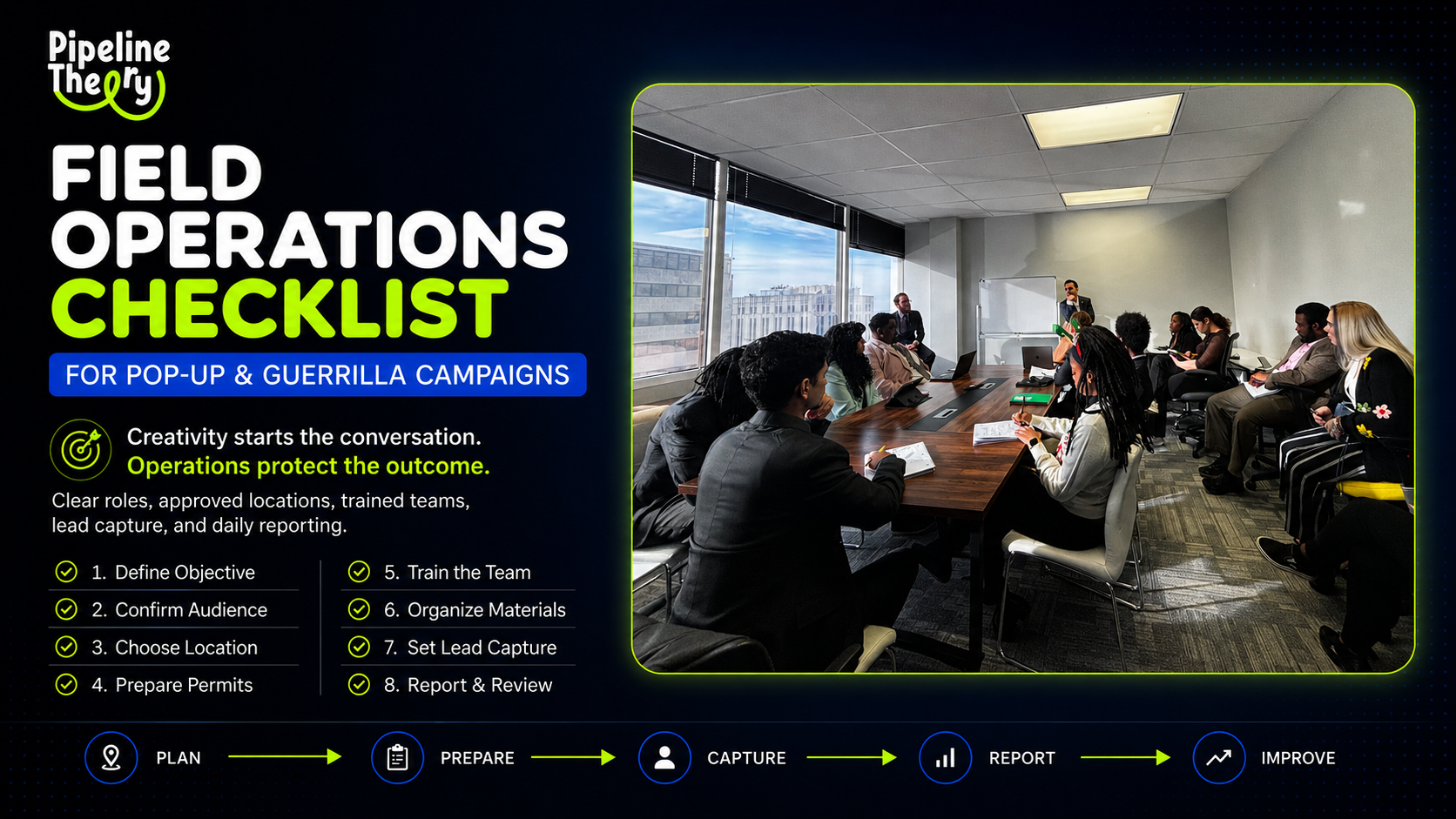
A successful pop-up or guerrilla marketing campaign is not built on creativity alone. Creative ideas can attract attention, but field operations turn that attention into measurable results.
Behind every strong field campaign, there is a system: trained people, clear roles, approved locations, lead capture tools, reporting standards, logistics, materials, communication and accountability.
Without that operational structure, even a promising campaign can become inconsistent, difficult to measure and hard to scale.
This checklist is designed for brands that want pop-up and guerrilla marketing campaigns to do more than create buzz. The goal is to build campaigns that start conversations, capture qualified leads and support a repeatable sales pipeline.
Why Field Operations Matter
Pop-up and guerrilla marketing campaigns often move quickly. Teams may be working in high-footfall areas, events, retail environments or specific local markets. The environment can change, customer behaviour can vary and the team needs to stay aligned throughout the day.
Strong field operations help campaigns stay organised.
They ensure that:
- Teams know their roles.
- Locations are prepared.
- Materials arrive on time.
- Customer conversations are consistent.
- Leads are captured correctly.
- KPIs are reported clearly.
- Issues are solved quickly.
- Results can be reviewed and improved.
Pipeline Theory provides field-first programs including pop-ups, event marketing, guerrilla teams, lead generation, list building, CRM integration and territory rollouts. You can explore these services on the Services page.
1. Define the Campaign Objective
Before planning logistics, define the campaign objective.
A pop-up or guerrilla campaign may be designed to:
- Launch a new product
- Test a market
- Generate qualified leads
- Drive on-site conversions
- Increase brand awareness
- Book appointments
- Collect first-party data
- Support a territory rollout
The objective will shape the rest of the campaign. A lead generation campaign needs a different setup than a same-day sales campaign. A market test needs different reporting than a brand awareness activation.
Clarity at the beginning prevents confusion in the field.
2. Confirm the Target Audience
A strong campaign is not just about being visible. It is about being visible to the right people.
Before launch, define:
- Who the campaign is trying to reach
- Where that audience is likely to be
- What problem the offer solves
- What message will create interest
- What action the customer should take next
This helps the team focus on quality engagement instead of random interaction.
3. Choose the Right Location
Location can make or break a field campaign.
The best location is not always the busiest. It is the place where the target audience, campaign objective and customer mindset align.
When reviewing locations, consider:
- Foot traffic
- Audience fit
- Visibility
- Permission requirements
- Space for engagement
- Weather conditions
- Nearby competitors
- Safety and accessibility
- Time of day
- Local rules or venue guidelines
For pop-ups, the location should support conversation and conversion. For guerrilla marketing, the location should allow the campaign to feel timely, relevant and brand-safe.
4. Prepare Permits and Approvals
Operational planning should include all necessary permissions before the team arrives.
Depending on the campaign, this may include:
- Venue approval
- Property permissions
- Local permits
- Event organiser approval
- Retail partner approval
- Insurance documentation
- Brand compliance review
This step protects the campaign from avoidable interruptions.
A field campaign should feel agile, but it should not feel improvised. The strongest campaigns move quickly because the right preparation has already happened.
5. Build the Field Team Structure
Every team member should know their role before the campaign begins.
A basic field team structure may include:
- Campaign manager
- Team lead
- Brand representatives
- Lead capture support
- Logistics support
- On-site sales representatives
- Reporting owner
The structure will depend on the size and complexity of the campaign. A small pop-up may only need a compact team. A multi-location campaign may need local managers, daily reporting leads and a central operations contact.
Pipeline Theory’s About Us page explains its focus on trained field teams, live data and repeatable playbooks. That combination is essential for campaigns that need to perform consistently in real markets.
6. Train the Team Before Launch
Training should happen before the team is in front of customers.
The team should understand:
- The brand
- The product or service
- The customer profile
- The campaign objective
- The opening message
- Qualification questions
- Objection responses
- Lead capture process
- Daily KPIs
- Reporting expectations
- Escalation process
Training should also include practice. A team that rehearses the conversation is more likely to stay confident and consistent during live execution.
7. Prepare Campaign Materials
Campaign materials should be organised before launch day.
This may include:
- Branded uniforms
- Tablets or phones
- Lead capture forms
- Product samples
- Brochures
- Signage
- QR codes
- Display materials
- Check-in sheets
- Backup chargers
- Wi-Fi or hotspot access
- Storage bags
- Sales scripts
- Reporting templates
Small details can affect performance. If a tablet is not charged, a QR code does not work or a representative does not have the right material, the customer experience can suffer.
8. Set Up a Lead Capture System
Lead capture should be simple, fast and consistent.
Before launch, confirm:
- Which tool will be used
- Which fields are required
- How consent will be recorded
- How leads will be tagged
- How duplicate entries will be handled
- How data will sync into the CRM
- Who checks data quality
- When leads will be reviewed
This connects the campaign to the sales pipeline. A strong pop-up campaign should not end with a list of names. It should create usable pipeline opportunities.
9. Establish Daily Reporting
Daily reporting keeps the campaign accountable.
Useful daily metrics include:
- Conversations started
- Qualified leads captured
- On-site conversions
- Sales opportunities
- Cost per lead
- Cost per acquisition
- Location performance
- Team performance
- Customer objections
- Operational issues
- Recommended adjustments
This allows managers to identify problems early and improve performance while the campaign is still active.
Pipeline Theory’s approach is built around live dashboards, daily KPIs, attribution and CRM integration. These elements help connect field activity with measurable revenue outcomes.
10. Create a Communication Plan
Field campaigns need clear communication.
Before launch, decide:
- Who the team reports to
- How updates will be shared
- When check-ins happen
- How urgent issues are escalated
- Where campaign documents are stored
- Who approves changes in the field
Clear communication prevents confusion and helps the team respond quickly when conditions change.
11. Review Results After the Campaign
The campaign is not finished when the team leaves the location.
After the activation, review:
- What worked
- What did not work
- Which location performed best
- Which message created the most interest
- Which objections appeared most often
- Which leads were strongest
- Which operational issues slowed performance
- What should change before the next campaign
This review turns field execution into learning.
The goal is not just to complete one campaign. The goal is to improve the system so future campaigns perform better.
Final Thoughts
Pop-up and guerrilla marketing campaigns can be powerful when they are supported by strong field operations.
Creativity may start the conversation, but operations protect the outcome. With the right planning, staffing, training, logistics, lead capture and reporting, brands can turn short-term activations into measurable pipeline growth.
For brands that want field campaigns to be more accountable, more organised and easier to scale, the operational checklist matters.
To learn how Pipeline Theory supports pop-ups, event teams, guerrilla marketing, CRM-ready lead capture and territory rollouts, visit the Services page or contact Pipeline Theory to discuss your next campaign.
FAQs
What are field operations in marketing?
Field operations include the planning, staffing, logistics, communication, reporting and on-site execution needed to run a marketing campaign outside a traditional office or digital environment.
Why do pop-up campaigns need an operations checklist?
A checklist helps teams stay organised, avoid missed details, maintain consistent messaging, capture leads correctly and report results clearly.
What should be included in a guerrilla marketing campaign plan?
A guerrilla marketing campaign plan should include the campaign objective, target audience, approved locations, team roles, materials, lead capture system, reporting process and communication plan.
How can field operations improve campaign performance?
Strong field operations improve performance by giving teams clear roles, better preparation, consistent data capture, faster problem-solving and more accurate reporting.